
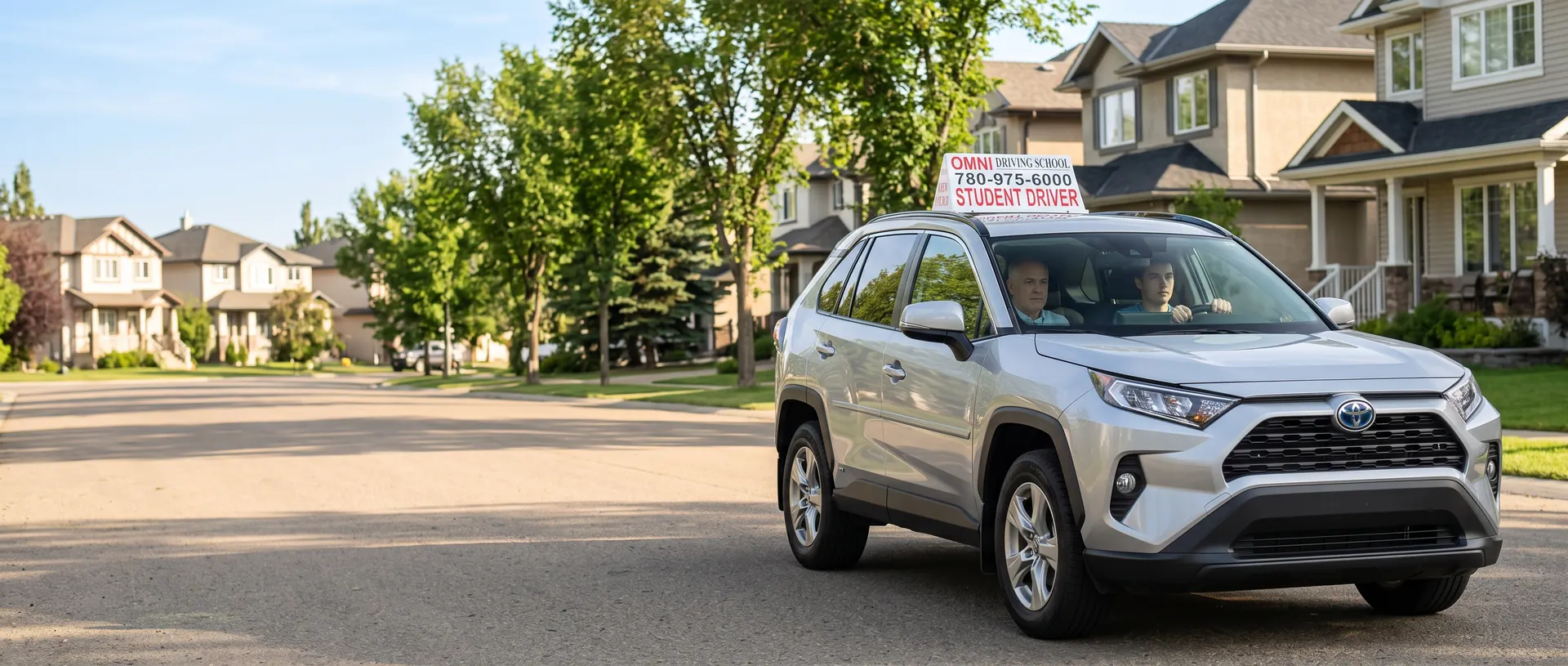
Safe Driving Tips for New Drivers in Alberta
Small habits, repeated on every trip, keep new drivers safe. Here is what to do before you leave, while you drive and when the rules are strict.
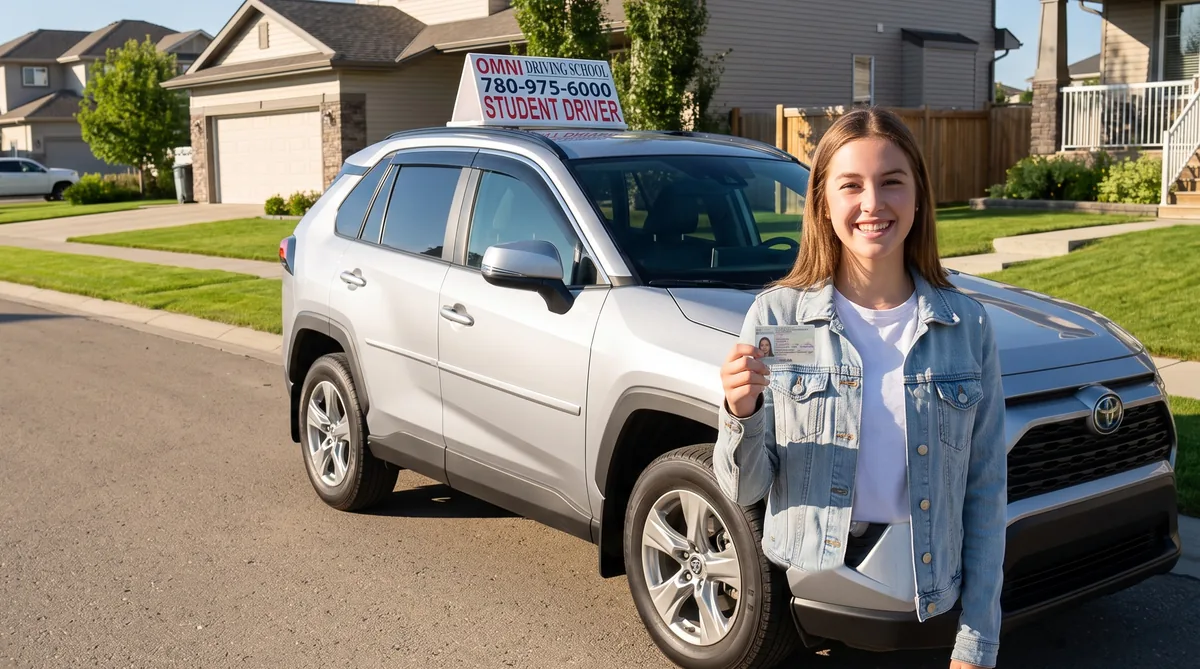
Start before the car moves
Most safe driving tips for new drivers begin before you turn the key. A minute of checks at the curb makes the rest of the drive easier.
- Check yourself. The Driver's Guide notes that stress, fatigue and lack of sleep all hurt your driving. If you feel tired, rest before you go.
- Stay sober. Learners and probationary drivers must have a zero alcohol and drug level when driving.
- Set your seat, head restraint and mirrors. In each side mirror, you should see a small part of your own car.
- Buckle up. Alberta law requires seat belts. The driver must make sure passengers under 16 are properly secured.
- Count the seats. Learners and GDL drivers may not carry more passengers than there are seat belts.
- Plan your route. Knowing your turns ahead of time prevents last-second lane changes.
Know the rules for learners
A Class 7 learner's licence comes with conditions, and they are there to keep practice safe. The Driver's Guide lists them.
- A supervisor beside you. Drive only with a fully licensed (non-GDL) driver who is 18 or older, seated next to you.
- No late nights. Learners may not drive between midnight and 5 in the morning.
- Zero alcohol and drugs. This applies every time you drive.
- Demerit limit. A learner is suspended at eight or more demerit points.
After the road test, a Class 5 GDL licence keeps the zero alcohol and drug rule and the seat belt limit on passengers. It is also suspended at 8 demerit points.
For parents, the supervising seat matters. Sit calmly, give instructions early and keep your phone away too.
Put the phone out of reach
Alberta's distracted driving law bans hand-held phones, texting and emailing while driving. You also may not enter information into a GPS or read while you drive. A GPS is allowed if it is fixed to the car and set before you start.
The Driver's Guide goes a step further. It advises against calls and texts even in hands-free mode. If you need to call or text, stop in a safe, legal place first.
One of the simplest safe driving tips for new drivers is to silence your phone and put it out of reach before you start. Choose your music and your route before you leave, too.
Drive at a speed that fits the road
A speed limit is the most you may drive when conditions are ideal. It is not a target. The Driver's Guide says any speed that is unsafe for the conditions is illegal.
- In towns and cities, the limit is 50 km/h unless a sign says otherwise. Towns can set their own limits by bylaw, so read every sign.
- In school and playground zones, slow to the posted speed while the zone is in effect. Our school zone guide explains the times.
- In rain, snow or darkness, slow down and add space.
Keep at least two seconds behind the vehicle ahead in normal conditions. On wet or icy roads, leave more.
Make room for emergency vehicles and workers
When an emergency vehicle comes up behind you with its siren or lights on, yield to it. On a two-way road, pull as close as you can to the right edge and stop until it passes. Then check that no other emergency vehicle is coming.
Stopped vehicles at the roadside need room too. When you drive in the lane closest to a stopped vehicle with flashing lights, Alberta says you must move to the far lane. This covers police, ambulances, fire trucks, tow trucks and maintenance trucks, including in construction zones. If you cannot move over safely, slow to 60 km/h or the posted limit, whichever is lower.
In construction zones, follow the posted speed and the directions of flag persons.
Watch for people walking and cycling
People on foot and on bikes have no metal around them. Give them time and space.
- At crosswalks, remember that every intersection has one, marked or not. Never pass a vehicle that has stopped for a pedestrian.
- Before a right turn, watch for cyclists riding beside your car. Do a shoulder check to the right before you turn.
- In parking lots, drive slowly. The same right-of-way rules apply, even without signs.
- Near parked cars, check your mirrors and look over your shoulder before you open your door.
Keep learning with feedback
Safe driving tips for new drivers turn into habits with practice and honest feedback. A certified instructor can spot things you cannot see yourself, such as late mirror checks or following too closely.
At Omni, the Full Course gives Class 7 drivers 15 hours of theory and 10 or 14 hours of driving. In all five areas we serve, hourly lessons are $50 an hour when you only need a little more time. All prices plus 5% GST.
When the basics feel natural, move on to our defensive driving tips. They teach you to read other drivers and leave yourself a way out.
Practise these habits with us
Put these safe driving tips for new drivers into practice with a certified instructor, one-on-one, in our car. Pickup and drop-off are free in all five areas we serve. Call or WhatsApp any day from 7:00 am to 9:00 pm.