
First Driving Lesson Tips: What Happens and How to Prepare
What to bring, what to expect, and how to feel steady in the driver's seat.
These first driving lesson tips are for anyone about to sit in the driver's seat for the first time. Feeling nervous is normal. Knowing what will happen, step by step, takes much of the worry away.
Before the day
Good first driving lesson tips start the day before, because a little planning makes the lesson itself easier.
- Your licence. You need your Class 7 learner's licence to drive, and Alberta law says it must be with you behind the wheel. Bring it to every lesson.
- Your shoes. Wear closed-toe shoes. Flat shoes with thin soles help you feel the pedals.
- Your glasses. If you wear glasses or contact lenses to see at a distance, wear them.
- Your body. Sleep well, eat something light, and bring water.
- Your pickup address. We pick you up at the address you gave when you registered. If it needs to change, agree the change with your instructor first.
On our Full Course, the 15 hours of theory come first. You finish them before your in-car lessons start, so the rules of the road are already familiar.
When your instructor arrives
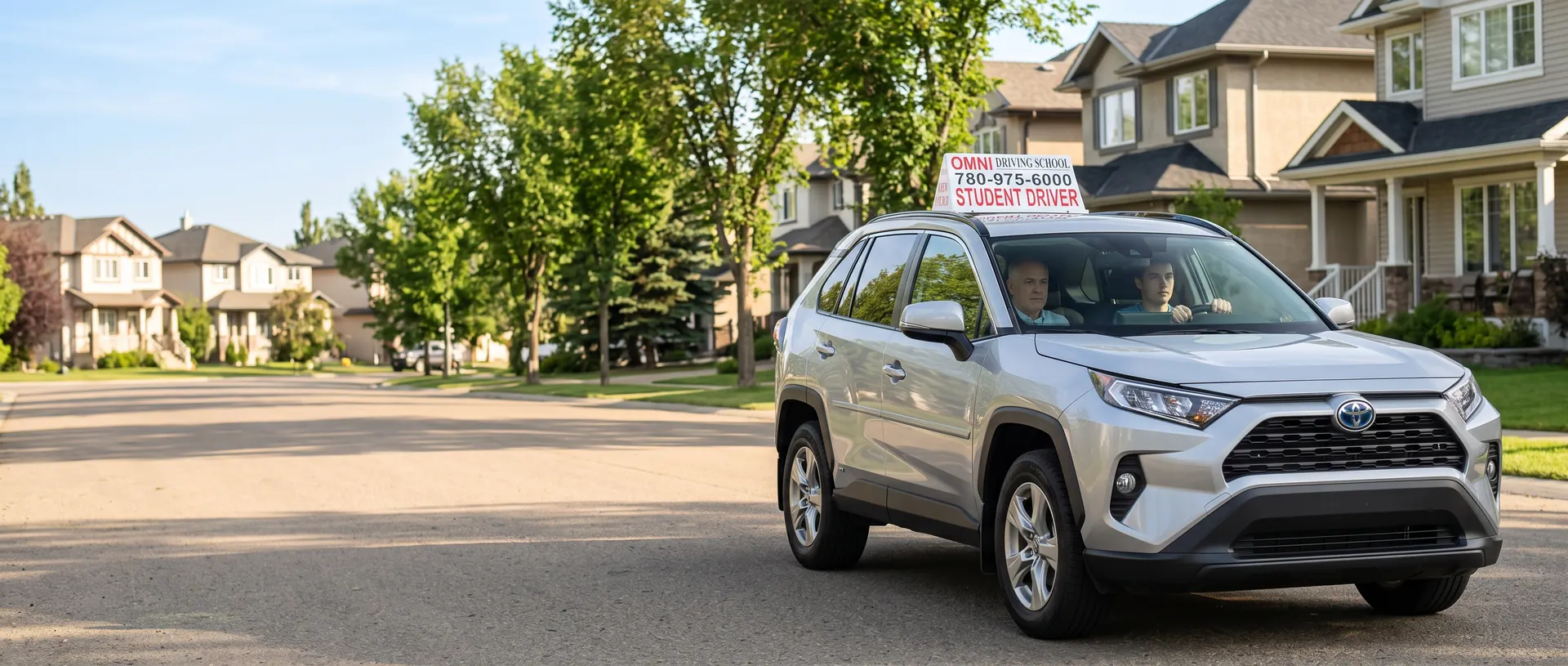
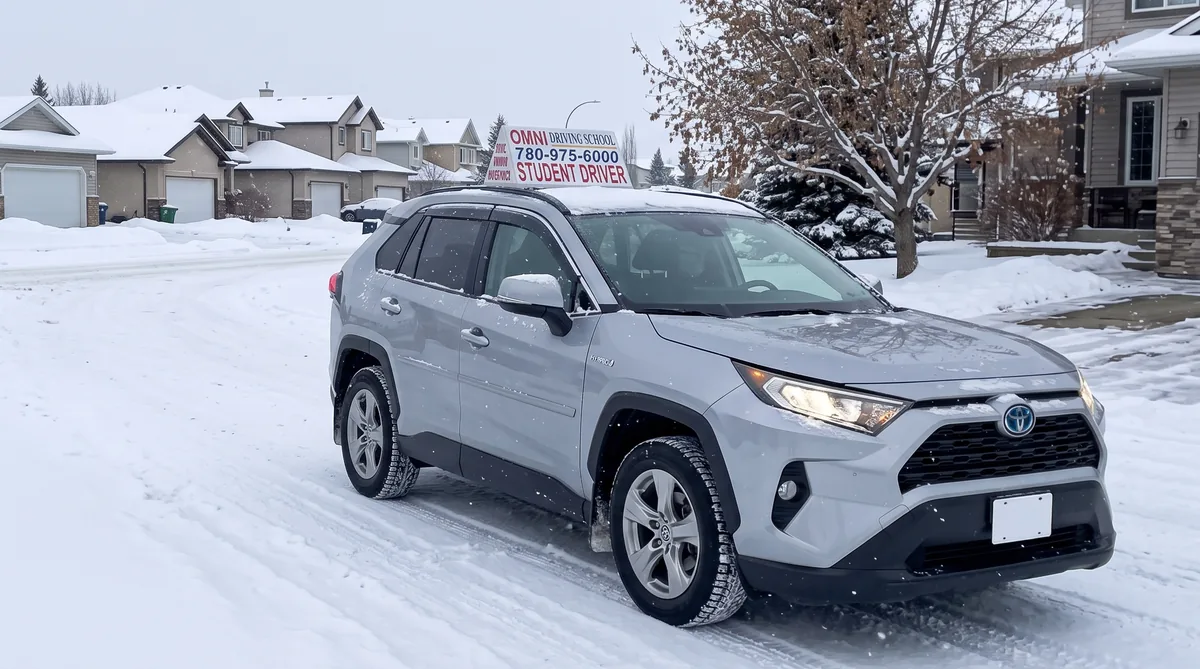
Be ready 5 minutes early. Your instructor arrives in our car, since road training is only given in Omni vehicles. Every lesson is one-on-one with a certified instructor, so it is just the two of you.
Quiet residential streets are a good place to begin, and they are part of what our lessons cover. The first few minutes are usually spent getting comfortable, not driving fast.
The pre-drive routine
The Alberta Driver's Guide sets out a routine to follow every time you get in. Do these in order:
- Lock your doors.
- Adjust your seat so you sit at least 25 centimetres from the steering wheel. Your elbows should be slightly bent.
- Adjust your head restraint so its centre is level with the top of your ears.
- Adjust your mirrors. Frame the rear window in the inside mirror. In each side mirror, you should see a small part of your own car.
- Fasten your seat belt, with the lap belt low and snug over your hips.
Hold the wheel with your left hand at about 9 o'clock and your right at about 3 o'clock. Before moving off, check that your path is clear, check your mirrors and do a shoulder check. When pulling away from the right side of the road, signal left.
What you may practise
Every learner moves at their own pace, but first lessons often focus on control rather than distance. Expect to work on some of these:
- The pedals. Gentle pressure on the accelerator, then smooth, early braking.
- Moving off and stopping. Doing both without a jolt takes practice, and that is fine.
- Steering. Look where you want the car to go, and your hands tend to follow.
- Signals and checks. Mirrors, signal, shoulder check, then move.
- Slow turns. Turning at a walking pace first, then at normal speed.
Over later lessons, the list grows. Our lessons cover city and highway driving, parking, lane changes, traffic circles, residential streets and road test preparation.
Handling nerves
One of the most useful first driving lesson tips is simple: tell your instructor how you feel. Our instructors are patient with beginners and nervous drivers, and they have 6+ years of teaching experience.
- Ask questions. Your instructor gives feedback during each lesson, and questions are part of learning.
- Take a pause. A 5-minute break is allowed in each lesson.
- Breathe at stops. A slow breath at each stop sign or red light helps you reset.
- Expect mistakes. Stalling, braking too hard or missing a check happens to every learner. Your instructor is there for exactly that.
- Use your language. Lessons can also be given in Punjabi and Hindi.
After the lesson
Spend five minutes writing down what went well and what felt hard. Those notes shape your next lesson and your practice drives.
Between lessons, practise with a supervisor. As a Class 7 learner, your supervisor must be 18 or older, hold a full, non-GDL licence and sit next to you. You also cannot drive between midnight and 5:00 am. Our post on the Class 7 licence lists every learner rule.
Wondering how many hours you will need in total? Our post on how many lessons to plan for sets out the options. If you need to cancel a lesson, give 48 hours' notice to avoid a late cancellation fee.
Common first-lesson questions
What if I have never driven at all?
That is what a first lesson is for. You start with the controls and simple moves, and you build from there. No one expects you to know how to drive yet.
Do I need my own car?
No. Road training is only given in Omni vehicles, and your instructor brings the car to your pickup address.
How soon can I take my road test?
Alberta says you must hold your Class 7 for at least one year before the Class 5 road test. You also need to be 16 or older.
Book your first lesson
Put these first driving lesson tips to work with a certified instructor beside you. Omni picks you up for free in all five areas we serve, and we answer every day from 7:00 am to 9:00 pm.